
WORKSHOPS and FREE READS SCHEME
Creative Writing Workshops
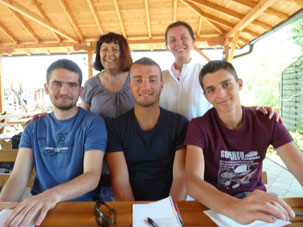
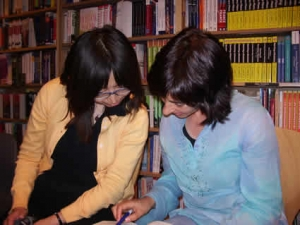


If you’re a refugee, immigrant or asylum-seeking writer and are interested in exploring your own poetry and prose, Exiled Writers Ink offers the following classes.
The classes are free but you need to join Exiled Writers Ink: £20 for the year. Join here https://www.exiledwriters.co.uk/exiled-membership/
If there are problems paying, please discuss this in confidence.
Register: exiledwritersink@gmail.com
Poetry Workshops with Tamsin Hopkins, award-winning poet (Monthly)

The last Wednesday of the month. 7pm to 8.30pm by Zoom. There will also be an optional extra half hour with technical material and exercises for those with the stamina for it, meaning that the finishing time for the whole event is 9pm. And optional homework for the really keen.
Everyone is welcome, whatever standard or experience. The exercises and material work for everyone, so come along and write with us.
Exciting sessions have included looking at how the techniques used in Mexican visual art might be helpful to us as poets.
Co-operative Support Group(monthly) facilitated by Omer Aksoy
Wednesdays mid-monthly, evening one hour long.
I collect the poems from you via email and collate them into a collective document to share with the whole group, so that people have a chance to read the poems before the session starts. In the session we discuss the poems randomly take turns to talk about what works well in the poem and what could be improved and how.. Mutual understanding and respect for each other are the only rules during our sessions.
We also bring a notable published poem for analysis for the last session of each term.
Prose Writing (Monthly)
Tutors: Elena Croitoru, published poet and award winner and Danielle Maisano, published novelist

This is a group designed for writers who are currently working on a novel/novella, memoir or other long-form prose projects. Each month writers will be selected in advance to present an excerpt from their current project for a critique and constructive feedback on their work. Depending on the readings, we hope to be able to explore different aspects and techniques as they arise and to offer continued and more in-depth support throughout the evolution of longer-term writing projects.
Last Tuesday of each month, 6 to 8 pm
 Exiled Writers Ink and The Literary Consultancy’s Free Read Scheme
Do you have a refugee or migrant background?
- Exiled Writers Ink is one of the Literary Consultancy’s partners and we are currently accepting submissions for the Scheme from those with refugee and migrant backgrounds.
- The Scheme is an opportunity for talented, low-income writers to receive professional feedback on their work. This will be a long, detailed report.
- Please now send your poetry or short stories or novels or play extracts to Exiled Writers Ink.
- We will assess it for quality and then forward it to The Literary Consultancy.
- Send in a 12 size font and double spaced, except for poetry.
- Send your work to exiledwritersink@gmail.com
Creative Writing Workshops for Refugees in the Community
Exiled Writers Ink has long run creative writing workshops for refugees in the community.
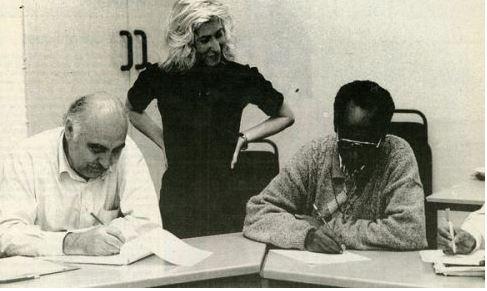
Also see the archive: https://www.exiledwriters.co.uk/creative-writing-workshops/
Training Exiled Writers for Teaching in the Community
Training for Teaching Creative Writing to Refugees in the Community
by Catherine T. Davidson
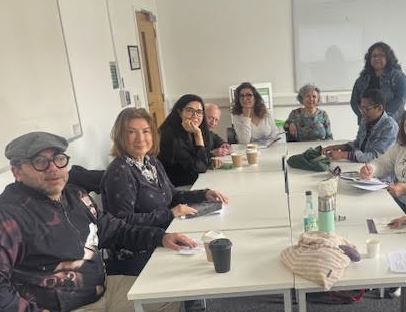
Writers gather in a Regent’s University London classroom
On Saturday, April 26th 2025 Exiled Writers Ink hosted a three-hour training session for writers interested in leading creative writing workshops for refugee and migrant community groups. Having done this successfully in the past, EWI was able to obtain a grant to expand this network.
Twelve writers attended, who came from a variety of countries, including Iran, Iraq, Nigeria, Turkey and Syria. All were published writers. The workshop was led by poet and novelist Catherine Temma Davidson, a member and former chair of EWI, currently teaching Creative Writing at Regent’s University, where the session was held.
The workshop focused on using objects and texts to inspire new writing and looked at the special needs and vulnerabilities of writing in a new language and new culture at a time of displacement and often in the wake of personal trauma.
Catherine Davidson led the workshop with lots of words of encouragement throughout, full of enthusiasm for the work of sharing creativity, and supportive of everyone there. She helped to set everyone at their ease, explaining that a facilitator needs to show: kindness, enthusiasm, curiosity, attention, respect. And she modelled this.
Catherine reminded us that “we use words to create worlds.” She emphasised that all in that room were poets and writers, whether they call themselves writers, or whether others call them writers: “If we write, we are writers.” That is true for the workshop participants as well. There is no right or wrong in this world of writing, but it is a process.
The presiding image for process was shown on a slide: the spiral staircase, starting in the dark basement of the self and moving to finding others. All of us have this creativity within us, at the bottom of the staircase, just waiting to come to the surface, to come to the light, to come to the open space. Putting words onto paper is the first step, it starts a process of discovery, of creation. You never know where it might lead.
There are different stages to climbing the spiral staircase. Some might be very unsure of how to bring out their own creativity, others may have climbed a few floors already, but we are all on this journey of discovering our own sense of creativity, through the medium of words. In this journey we may revisit what we have previously written, or find new ways of expressing what we wish to communicate; it is a spiral staircase, not a linear journey.
So, how do we encourage others to use their creativity with words? Catherine provided us with a tool kit to work with, using observation, memory and imagination.
We can start with any materials that may be around us. What do you see? be curious and write it down in words, using all of your five senses, of sight, smell, hearing, touch and taste, where appropriate.
Then, bring other dimensions associated in your mind with such objects, associated with the past, such as your memory of people, places, food, smell. Or associated with people or places you have never known, with distant past or with the future, but come alive in your imagination.
Your writing can take you in any direction in which you find inspiration, or anything that is brought up in association with the original object, animal, tree, construction, place or natural element that you started with.
Participants had a chance to practice various techniques, and prompts. They were also given a list of suggested prompts and Catherine shared work that had been produced in a workshop at a homeless shelter and a refugee welcome centre with the prompts. She talked about her experiences, what went well and not so well and her ideas about why.
It was really fascinating to hear at the end of the workshop all the different pieces of writing that came out of the writing workshop, demonstrating the myriad of directions and perspectives taken by those present. We were all on our individual journeys but inspired by what we heard and seen, touched and smelled in the course of the afternoon.
A highlight was a visit to the campus ‘secret garden’ where we gathered sense information and enjoyed the beautiful afternoon.